Image Map
Showing posts with label Rhythm Activities. Show all posts

Sunday, July 27, 2014

Goldilocks and the 3 Bears Visit the Music Room

Somehow, summer always breezes by and the long list of to do's and ideas never gets completely accomplished, even with the best intentions.  Goldilock's transformation to a music and literature story has been at the top of my list for awhile and it is finally done for you TODAY!


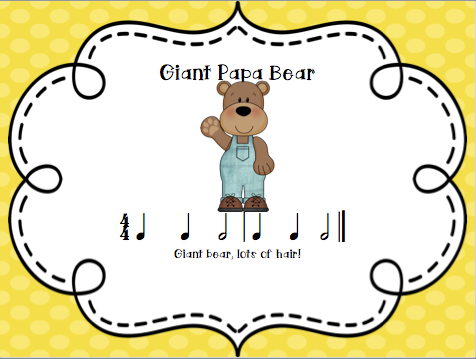
This set includes directions, 7 rhythm ostinato cards, and a pictoral story to be incorporated along with the children's folk story, "Goldilocks and the Three Bears." After learning each character's ostinato part,

it will be inserted into the story every time the character is mentioned. The story is written out and graphics are inserted every time an ostinato is to be chanted (ex. every time the wee little bear is named, the baby bear rhythm ostinato will be performed in the story.) Students can read the story or the teacher can. Ostinatos can be performed as a whole class or in small groups. Instrumental suggestions are also included for each character. Speech interjections for the story are also color coded for ease of students and the teacher.


Using half notes, quarter notes, quarter rests, and eighth Notes, this activity is great for students who are familiar or may come across this book in their reading classes as well. Great cross curricular activity that is engaging for students and meets music standards while incorporating literacy as well. A final performance can be created and shared as well.
I hope your students enjoy bringing this beloved folktale to life, as much as I loved creating it! 

Thursday, April 3, 2014

Jelly Bean Rhythm Set

I just finished a rhythm set that I just love and can't wait to get my 2nd graders back from my student teacher so I can put it in action!!

In this combo pack are two things: Ostinato Cards and a Rhythm Sort worksheet in black and white and color. 


The ostinato cards work as my other ostinato sets.  Students can chant the speech and then learn the corresponding rhythm for the speech (print on the back of the cards).  They can then perform these in speech ensembles or instrumental ensembles.  As the teacher, you can arrange it, or you can put the musical decision making in the hands of your students and let them do the arranging.


The worksheet included asks students to read the names of jelly bean flavors and then sort them by gluing the jelly beans into the jar with the corresponding rhythm on it. 


Two ways to practice rhythms in one great set!  Enjoy! 

Collaborating with Carle

Hi All!  Sorry for the lack of posts lately.  I've had a student teacher and haven't been teaching as much.  It's amazing how the kids inspire ideas.  When I'm not directly working with my kids and the standards, my creative juices aren't always flowing as well.

This cycle and next cycle (at least) we are doing a creative partnership across three enrichment areas: Music, Library, and Art.  It's pretty cool how it's all worked out so I thought I'd share with my blog world friends.

I have been working on some Eric Carle cross curricular lessons for my first grade students.  While talking with the art teacher, we realized that as part of her curriculum, she was teaching a lesson on Eric Carle's illustration art work to teach wet on wet watercolor technique.  We decided to partner together to make these things happen at the same time.  Then, we pulled in the librarian, who pulled out every Eric Carle book that has ever been published to decorate the library, and be the focus of an author study for her lessons this week.

So, within the last four days, the kids have learned about Eric Carle as an author and illustrator in library, painted wet on wet water color paper to create the wings of a paper butterfly they are going to create, and they have added rhythm add on patterns to The Very Hungry Caterpillar. 


Next cycle, they will learn more about Eric's books in library, finish their butterfly in art (and we will then photograph the butterfly on white paper) and they will add instruments to their Caterpillar performance.

As a culmination of this, the following week, I will take the photographs of their art work that I will take and print the butterfly's out.  The students will then draw a pathway for the butterfly to fly.  We will turn this into a book, and will use it as a vocal exploration warm up.

I just love when we can all work together for the good of kids.  I love it even more when these collaborations happen naturally, easily, or even coincidentally! 

Don't want to use the Hungry Caterpillar?  Check out my other Eric Carle music and literature sets instead!
Does Kangaroo Have a Mother Too?
Polar Bear, Polar Bear

Monday, March 3, 2014

Circling Up to Practice Rhythm Reading and Performance

I took video and pics this week (without kid's faces to identify them) to share with you one of my favorite ways to practice rhythms. 

I have created a Teachers Pay Teachers set for this (at three levels, one with quarter and eighth rhythms, one adding in half notes, and one adding in 16th notes), but you may want to just use your own rhythms on sentence strips too.  If it is easy to buy the set ready to go with suggestions, go for it.  If not, create your own :-)


To start this activity, I help the kids discover that each card has the exact same number of beats (some have to be coached through the value of each note and the math to totally get this concept.)  Then, we practice all saying our cards at the same time.  I walk around to clarify and assist students who are struggling with their patterns.  We hone this until we all start and actually end together!  After mastering that, we move between the cards, using 4 beats to chant, and 4 to move to the next pattern.  Once they can do this together in time, we add music to the performance, using the beat of the piece (song suggestions in the Circle-Up Sets in my store).  I assess student performances informally by standing by a card and hearing every student perform it as they walk by, or by walking and listening to several perform at one time. 

The video below shows you an early step in the process of perfecting this activity.  You'll hear my voice coaching them for the moves.  I like to get them to the point where they internalize the four beats between and don't need my constant counting to keep them together.  It's a building process to get there.  


The kids think they are rock stars and it really helps them solidify some early ensemble skills, along with important rhythm skills.

Hope this sparks some ideas for rhythm practice for you.

Sunday, March 2, 2014

Another Fun Children's Literature and Music Picture Book Connection

I've been loving coming back to some classic children's literature to bring it to life in my music classroom.  Since I just love stories, adding stories and music gets me super excited.

This newest set uses one of my favorite early literacy books, "If You Give a Mouse a Cookie."  Using half note, quarter note, quarter rests, and eighth notes, this set adds four beat rhythm phrases after each "demand" of the mouse.  Students can read and perform the phrases on text only or using rhythm syllables after performing the text.
Each page has a four beat ostinato that has text correlating to the mouse's most recent demand.  These patterns can also be transferred to unpitched percussion or a xylophone set in pentatonic.


Happy "Kid-Litting!"

Wednesday, February 26, 2014

Children's Literature Sets

Those of you who follow my blog know that I looooove using children's literature in my classroom.  I end every first grade class with a song tale picture book.  However, I also love using children's literature as a springboard for improvisation, for rhythm activities, for melodic song incorporation, and for instrument playing.

I've just finished up two sets to share with you, to help you implement children's literature in your music classroom too.  (Note: Awesome classroom teachers who love to add music into their language arts lessons could also do this.  Gotta love music spreading outside of the music room and filling the school!)

The first set I finished goes with Eric Carle's Hungry Caterpillar book.


This set has four beat rhythm patterns to be chanted for each day's caterpillar dining.  Quarter and eighth notes are practiced, and an ostinato ensemble can even be performed.  Directions are included for making this rhythm activity a cross-curricular success.


The second set that is hot off the press goes with the book, "The Mitten."  In this set, I wrote a two measure sol mi la (and a few do's) melody for each character in the circular story.  Each page in the book has a melody to tag on to the prior melodies, making a longer and longer song.  Ideas for incorporating Orff instruments are also included.  Recordings of the song come along with the set, so classroom teachers who would like to use music in their language arts lessons can use the recordings to perform the songs with the book.  Three versions of slides are including, showing the text with a pictoral version of the solfege for the melodies, a version including just the text for each mini song, and a version including the notation for each mini song.  A copy of the sheet music is thrown in there too.  What more could you want or need? 


I can't wait to use these sets with my kids.  Hope they bring joy to your classroom as you share a love of music alongside a love of reading!

Saturday, February 15, 2014

Rain on the Green Grass Poem + Boomwhackers = Surprisingly Effective

I have to admit that I've never been a huge fan of boomwhackers.  I always felt like, with a full room of Orff instruments, why would I use something that doesn't make as musical of a sound. 

However, this school year, I have been converted a bit in the boomwhacker department.  I teach two part time learning support classes who are only pushed out for their specials (music, pe, art, library).  Getting vocal sound out of the small group is very challenging and activities requiring fine motor skills, such as xylophone playing, can be quiet difficult.  We push through those activities anyway, don't get me wrong, but it is not easy. 

It hit me that I had a stash of boomwhackers in the closet from the teacher who taught before me.  I realized, in an epiphany, how perfect these simple colored tubes were for working with this class.  Each of us has a color, we follow along, and we make music.  I wish I was permitted to upload video of them, because the end products have been pretty neat and touching. 

So, when followers on my Treble in the Classroom facebook page  (follow if you don't already...I often give away flash freebies!!) asked for boomwhacker resources, how could I say no?  I now know there are ways to use them in meaningful ways. 

So, on my snow day yesterday, I created my first boomwhacker set, using the poem Rain on the Green Grass.  Some of you may know the sol mi la version of this song.  This is not it.  It merely uses the familiar poem text to set to boomwhacker melodies. 

This set has the poem "Rain on the Green Grass" notated rhythmically and melodically. It is the traditional text with slight adaptation and a melody I composed. Quarter, Eighth Notes, Half Notes, and one Whole Note are used. This set includes slides with lyrics to the "Rain on the Green Grass" poem, Colored Rhythm slides, Colored Melodic Notation Slides, Colored Accompaniment Slides, and Colored Ensemble Slides. A melody and accompaniment are included. Accompaniment could be played with boomwhackers as well, or on Orff Instruments.

A "Fill in the Missing Rhythms" worksheet from the melodic rhythm is included as well.

Thursday, February 13, 2014

Mi Re Do and Half Note Combination Activity Sets


I've been working on mi re and do with my second graders melodically and half notes, rhythmically.  I decided to pull together some new sets for my second graders, and was inspired by some of the songs my 3rd grade recorder players are working on.

The first set I completed goes along with the song Down by the Station.  There is so much instruction available in this very little tune.


Included in this kit are:
1. Down by the Station Solfege Set: These slides will allow students to see Down by the Station notated pictorally, on a 5 line staff, and in G major.

2. Down by the Station Rhythm Identification Set: These slides will allow students to see the rhythm of the song written in pictures, with pictures and rhythms, and with text and rhythm notation.

3. Down by the Station Rhythm Dictation Worksheets: 2 worksheets allow students to dictate the rhythm of the song in 2 slightly different ways.

4. B Section Composition Word Chain Cards: These cards allow students to learn about Rondo form, while accomplishing the difficult standard of composing and arranging. Students will use the provided word chain cards to compose their own B section in groups. Directions for creating a whole piece performance as a class are provided.


After creating this set, I thought Merrily We Roll Along could be used in very similar ways, so I made the same type of set with a different song and theme.


Included in this set are 4 files:
1. Merrily We Roll Along Solfege Set: These slides will allow students to see Merrily We Roll Along notated pictorally, on a 5 line staff, and in G major.

2. Merrily We Roll Along Rhythm Identification Set: These slides will allow students to see the rhythm of the song written in pictures, with pictures and rhythms, and with text and rhythm notation.


3. Merrily We Roll Along Rhythm Dictation Worksheets: 2 worksheets allow students to dictate the rhythm of the song in 2 slightly different ways.

4. B Section Composition Word Chain Cards: These cards allow students to learn about Rondo form, while accomplishing the difficult standard of composing and arranging. Students will use the provided word chain cards to compose their own B section in groups. Directions for creating a whole piece performance as a class are provided.


Slides and Ladders

Last evening, in anticipation of ANOTHER snow day today, I was thinking about a rhythm game to create.  I remembered a game that I loved playing as a kid, and have recently played with my nephew, and was inspired to create this next set for my students, and yours!


Slides and Ladders is a familiar game to kids.  Included in the set are a game board (for 2-4 kids), directions, and printable game pieces.  You will need to provide dice.

Students will roll a dice and then move their marker that many spaces. They must read the rhythm pattern that is on the square they land on. If they do not perform it correctly, as determined by their group members, they must move back to where they were before rolling. If they land on a ladder and perform correctly, they will climb up to the higher square. If they land on a slide, they will slide back down to the square it directs to. The first one to the end is the winner of the game!
Note: Rhythms Look Difficult to Read Here, but That is Due to Shrinking the Size of Photo for Uploading.  Display is clear for your downloading and printing!


This is to be performed in small groups for 2-4 students. Great for station work or whole class small group work. Also great for a music substitute if students are familiar with the rhythm patterns.


I know that before playing this in my room, the students will need to be reminded to cooperate and accept the criticism of their teammates who may let them know they performed incorrectly.  I will serve as the ultimate "referee" but hope the kids can solve most of the difficulties on their own.


There are six versions of this game, and a bundled set of them all.
1.  Quarter and Eighth Edition
2.  Half Note and Rest Edition
3.  Sixteenth Note Edition
4.  Syncopated Edition
5. Ti Tika Edition
6.  Tika Ti Edition
7.  Bundled Combo (Save $5)

Monday, February 3, 2014

BAM: Rhythm Performance Practice Game

I was pintersting today and found a cool game idea for use with sight words.  I thought to myself, this could be used for rhythm performance practice too, so BAM, I spent this afternoon and evening creating it for YOU and for ME.

To play BAM, students take a rhythm card off of the top of the stack. If they perform it correctly, they keep it. If they do it incorrectly (as deemed by the others in their group or the teacher, depending on how you set up your playing time), the card goes to the bottom of the pile. The goal at the end of the game is to have the most cards. However, if a BAM card is drawn, the student has to return all of the correct cards that they have collected to the pile. I play this as a timed game for x amount of minutes.


This can be played with multiple groups playing in your classroom at one time, or as a station in centers rotation.  As a teacher, you could be working with a small group on this activity, or allowing students to regulate the performances themselves.  I recommend discussion expectations for correcting each other ahead of time.


I created several versions:
Quarter and Eighth Notes (and quarter rest)


Half, Quarter, and Eighth Notes (and quarter and half rests)


Sixteenth Note Set (plus above rhythms)


Syncopated Set (plus above rhythms)


Ti Tika Set (plus above rhythms)


Tika Ti Set (plus above rhythms)


Then, because I know some of you would like to do this with  multiple levels, I created a combo pack of all 6 sets.


I'll be printing and laminating these tomorrow so I can cut them out on the predicted upcoming snow days as the week progresses!